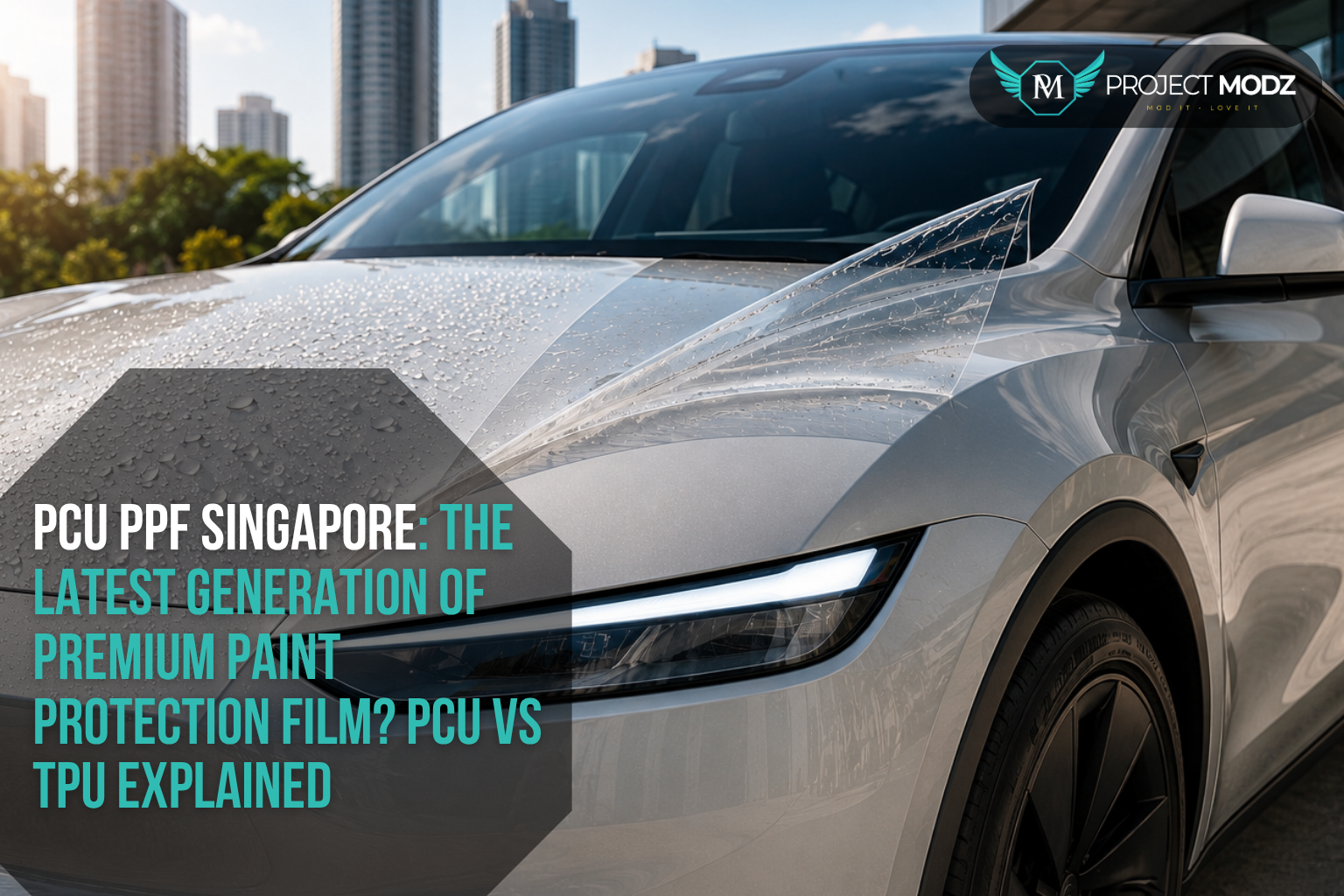
Paint Protection Film technology has evolved significantly over the years.
For a long time, TPU (Thermoplastic Polyurethane) PPF has been considered the premium standard for automotive paint protection. High-quality TPU offers the flexibility, clarity, impact resistance and self-healing characteristics needed for protecting modern vehicle paintwork.
Now, another material technology is attracting attention in the premium PPF market:
PCU — Polycarbonate Urethane, or polycarbonate-based polyurethane.
PCU-based PPF is being positioned at the top end of the market, particularly for applications where long-term resistance to heat, moisture, chemicals and environmental ageing is important. The polycarbonate chemistry used in PCU can provide improved hydrolytic stability compared with some conventional polyurethane formulations.
For Singapore car owners, this is particularly interesting.
Our vehicles operate year-round in a hot, humid tropical environment, making heat, moisture, UV exposure and environmental durability important considerations when selecting a PPF.
But is PCU really better than TPU?
And should you choose PCU PPF for your next car?
At Project Modz, we believe customers should understand the material going onto their vehicle rather than choosing a PPF simply because of a new technology name. Whether you’re considering the latest PCU technology or proven TPU, choosing the right Paint Protection Film (PPF) in Singapore starts with understanding the material, installation quality and protection your vehicle actually needs.
Let’s take a closer look.
TPU stands for Thermoplastic Polyurethane.
It has been one of the most established premium materials used in modern automotive Paint Protection Film.
Quality automotive TPU PPF is popular because it can provide an excellent combination of:
These characteristics have helped TPU become a benchmark material for premium PPF.
When properly manufactured and installed, a quality TPU PPF remains an excellent choice for protecting vehicle paintwork.
This is important because the emergence of PCU does not suddenly make good TPU PPF a poor product.
The real comparison is between two different approaches to premium polyurethane film technology.
PCU commonly refers to Polycarbonate Urethane or polycarbonate-based polyurethane.
Rather than thinking of PCU as something completely unrelated to TPU, it is more accurate to think of it as an advanced polyurethane formulation using polycarbonate chemistry.
In these materials, polycarbonate-based segments are incorporated into the polyurethane structure.
Why does that matter?
Polycarbonate-based polyurethane materials can offer strong resistance to:
These characteristics are why polycarbonate-based polyurethane technology has attracted attention for demanding applications, including newer premium automotive protection films.
For PPF manufacturers, the objective is straightforward:
Maintain the flexibility and protection expected from premium polyurethane while improving long-term environmental stability.
The main difference starts with the polymer chemistry.
Traditional premium TPU already provides excellent flexibility, clarity and impact protection.
PCU uses polycarbonate-based polyurethane chemistry designed to improve certain material properties, particularly resistance to hydrolysis and environmental ageing.
A simplified comparison looks like this:
| Feature | Premium TPU PPF | PCU-Based PPF |
|---|---|---|
| Paint protection | Excellent | Excellent |
| Flexibility | Excellent | Excellent |
| Optical clarity | Excellent with premium films | Potentially excellent |
| Self-healing | Available | Available |
| Hydrophobic top coat | Available | Available |
| Impact resistance | Excellent | Excellent |
| Hydrolysis resistance | Good | Potential PCU advantage |
| Heat/environmental stability | Good to excellent | Potential PCU advantage |
| Industry history | Very established | Newer in automotive PPF |
| Price positioning | Premium | Typically top-tier premium |
The important word here is potential.
PCU chemistry may provide material advantages, but that doesn’t automatically mean every PCU-labelled film will outperform every premium TPU film.
A PPF is a complete engineered system—not simply a base polymer.
Singapore creates demanding conditions for automotive exterior materials.
Cars are regularly exposed to:
High temperatures.
High humidity.
Strong sunlight.
Heavy rainfall.
Road contamination.
Frequent temperature changes between outdoor parking and sheltered environments.
This makes hydrolysis resistance particularly interesting.
Hydrolysis is essentially material degradation associated with reactions involving water or moisture. Polycarbonate-based polyurethane chemistry is known for strong hydrolytic stability, which is one reason PCU is being explored for premium PPF applications.
For Singapore’s hot and humid climate, that characteristic could be valuable when combined with a properly engineered automotive film.
PCU is certainly one of the newer premium material developments being marketed in automotive PPF in 2026.
However, we prefer not to describe every new material as automatically being the “best.”
Technology should prove itself through performance.
What makes PCU interesting isn’t simply that it is newer.
It’s the potential improvements its chemistry can offer in areas such as environmental stability, hydrolysis resistance, heat ageing and long-term performance.
That is a much more meaningful reason to consider it.
This is potentially one of PCU’s most important advantages.
A vehicle’s PPF spends its entire life exposed to the environment.
In Singapore, that means moisture and heat are unavoidable.
Polycarbonate-based polyurethane materials can provide particularly strong resistance to hydrolysis compared with some conventional polyurethane chemistries.
Why does this matter?
The longer a film remains on a vehicle, the more important its ability to maintain its physical and optical characteristics becomes.
PPF isn’t something we evaluate only on the day it is installed.
Long-term stability matters.
Cars parked outdoors in Singapore can experience significant surface temperatures.
The bonnet, roof and other exposed panels can become extremely hot under direct sunlight.
Heat resistance therefore matters for any exterior automotive film.
PCU-based polyurethane chemistry is being promoted partly because of improved heat-ageing characteristics and environmental stability.
Again, this doesn’t mean conventional premium TPU cannot handle Singapore conditions.
Quality TPU PPF has been successfully used on vehicles for years.
Instead, PCU represents an attempt to push certain performance characteristics further.
One of the biggest concerns with clear PPF is maintaining transparency over time.
Nobody wants to install a crystal-clear film only to see it become noticeably discoloured later.
Modern premium TPU has already improved substantially in this area.
Quality aliphatic TPU can offer excellent UV resistance and colour stability.
PCU-based PPF aims to build further on long-term environmental and optical stability.
However, yellowing resistance isn’t determined by the polymer name alone.
The quality of the:
can all influence long-term appearance.
This is why we don’t recommend buying PPF purely because the packaging says PCU or TPU.
Premium PCU PPF can incorporate self-healing surface technology, just as premium TPU PPF can.
Self-healing generally allows certain fine surface marks and light scratches in the film’s top layer to recover with heat.
That heat may come from:
But self-healing should always be understood realistically.
It doesn’t mean deep scratches, cuts or severe stone impacts will magically disappear.
PPF is a protective sacrificial layer.
It is not an invisible suit of armour.
Premium PPF can also feature a hydrophobic top coat.
This helps water form beads and move away from the surface more easily.
Potential benefits include:
But once again, hydrophobic performance comes largely from the surface coating technology.
It isn’t automatically guaranteed simply because a film uses PCU chemistry.
A high-quality TPU PPF with an excellent top coat could have better hydrophobic behaviour than a poorly manufactured PCU film.
Both can provide excellent clarity and gloss when properly manufactured.
Premium TPU PPF can already produce outstanding optical results.
Some manufacturers of PCU-based films position their products as having enhanced gloss retention and optical stability.
But when choosing PPF, we recommend seeing the material yourself.
Look at:
A specification sheet can tell you a lot.
Your eyes can tell you something too.
This question is more complicated than it appears.
Film strength isn’t determined by one characteristic.
PPF needs to balance:
Strength + flexibility + elasticity + impact absorption + optical clarity + adhesive performance.
Making a film simply harder doesn’t necessarily make it better.
A PPF needs enough flexibility to conform to complex automotive panels while retaining the mechanical characteristics required for protection.
PCU-based polyurethane can offer strong mechanical and environmental properties, but the finished film’s actual performance depends on its entire construction.
Both premium TPU and PCU-based PPF are intended to create a physical sacrificial layer over vehicle paint.
This can help protect against:
However, no PPF can guarantee complete protection against every impact.
A sufficiently large or high-speed object can damage the film and potentially the paint underneath.
The purpose of PPF is to reduce the risk and severity of everyday paint damage, not make the vehicle indestructible.
Customers often compare PPF by asking:
“How many mil?”
Thickness matters—but it isn’t everything.
For example, an 8.5 mil film isn’t automatically better than every 7.5 mil film.
You also need to consider:
The complete film matters more than one number on the specification sheet.
This is where the answer becomes practical.
You want a proven premium PPF technology with an established history in automotive paint protection.
Good TPU remains an excellent choice for:
High-quality TPU provides the flexibility, transparency and impact resistance that have made it the premium PPF standard for years.
You are looking for a top-tier, newer-generation PPF material and place particular emphasis on:
This can make PCU especially interesting for owners of new, luxury, performance and exotic vehicles.
No—and this is important.
A good PCU PPF may offer advantages over a conventional TPU formulation.
But PCU on the label does not automatically mean the finished film is superior.
Likewise, a premium TPU film from a well-developed film system can outperform a lower-quality product that simply uses PCU as a marketing term.
One PPF manufacturer explicitly notes that PCU can show better raw-material hydrolysis and heat resistance, while cautioning that these laboratory advantages don’t automatically produce a better finished automotive film.
This is why Project Modz believes customers should look at the complete product, not just one technology name.
Think of premium PPF as a system.
Several components work together:
Provides much of the film’s mechanical structure.
Influences characteristics such as self-healing, stain resistance, surface feel and hydrophobic behaviour.
Determines how the film adheres to the vehicle and behaves during installation and eventual removal.
Consistency across the roll matters.
Even the most advanced film cannot compensate for poor installation.
This final point is particularly important.
You can purchase the most advanced PPF available.
But if it is installed poorly, the result will still be poor.
Professional PPF installation requires experience with:
Modern vehicles are increasingly complicated.
The installer isn’t simply applying film.
They are working around expensive paint, trim, sensors, cameras and vehicle components.
At Project Modz, our philosophy remains:
The car underneath the film comes first.
This is why choosing an experienced workshop for professional PPF installation in Singapore can be just as important as choosing between PCU and TPU film technology.
New PPF technologies are appearing rapidly.
That makes quality control more important—not less important.
We don’t believe a customer’s vehicle should become a testing ground simply because a product has a new technology name.
Before recommending a premium film, we consider the characteristics that matter in actual automotive use.
That includes:
Newer is interesting. Proven performance is more important.
Owners of luxury, sports and performance vehicles are often particularly concerned about preserving original paint.
Stone chips on areas such as the bonnet, front bumper and fenders can be frustrating and potentially expensive to rectify properly.
For these owners, a top-tier PPF solution can make sense.
PCU-based PPF is particularly interesting where the owner wants the newest generation of premium material technology combined with professional installation.
But the same principle applies whether we’re protecting a supercar or a daily-driven family vehicle:
Use a film suitable for the car and install it properly.
If you’re still deciding whether paint protection is necessary for your vehicle, read our complete guide on is PPF worth it in Singapore?, where we explain stone-chip protection, self-healing technology, full-car versus partial PPF and what car owners should consider before installation.
A new vehicle is arguably one of the best times to consider PPF.
The paint is generally in its best condition.
Instead of waiting until stone chips and scratches accumulate, PPF allows you to create a sacrificial protective layer earlier.
For maximum exterior protection, owners may consider full-car PPF.
Alternatively, high-impact areas can be prioritised, including:
Your ideal coverage depends on how you use the car and how particular you are about its condition.
Don’t simply ask:
“Is this PCU?”
Ask more.
Understand what you’re buying.
Useful—but don’t use thickness as the only comparison.
This can significantly influence self-healing and surface performance.
Find out what the warranty actually covers.
Ask about clarity, stain resistance, hydrophobic performance and environmental stability.
Because even premium material requires premium workmanship.
PPF is a long-term product. Your relationship with the installer shouldn’t end when you drive away.
TPU isn’t obsolete.
Premium TPU remains one of the most proven and capable materials for automotive Paint Protection Film.
PCU-based polyurethane represents an interesting next step in premium PPF material development, particularly because of its potential resistance to hydrolysis, heat ageing and demanding environmental conditions.
For Singapore, where vehicles operate in a consistently hot and humid environment, those characteristics make PCU especially interesting.
But we believe the correct approach is not:
PCU = good. TPU = bad.
Instead:
Premium TPU = proven high-performance protection.
Quality PCU = newer top-tier material technology with potential advantages in specific areas.
And whichever you choose:
Film quality + material QC + proper preparation + experienced workmanship matter.
PCU and TPU describe technologies used within PPF, but PPF itself should not be confused with traditional vinyl wrapping. If you’re deciding between protection and colour transformation, see our guide to PPF vs car wrap vs Colour PPF in Singapore.
At Project Modz, we continuously evaluate developments in automotive protection films because the technology protecting your vehicle should evolve as materials improve.
From proven premium TPU Paint Protection Film to the latest generation of PCU-based PPF technology, our focus remains the same:
Quality material. Proper QC. Experienced installation. Maximum care for your vehicle.
Your car deserves more than a film chosen because of a marketing label.
It deserves the right protection, installed the right way.
If you’re considering PPF for your new car, luxury vehicle, EV, sports car or daily drive, speak to Project Modz about the appropriate protection option for your requirements.
Contact Project Modz and have your car protected.
Project Modz — The Difference Is In The Details. Since 2017.
📍 53 Ubi Ave 1, Paya Ubi Industrial Park #01-35, Singapore 408934
📲 WhatsApp: 8061 1616