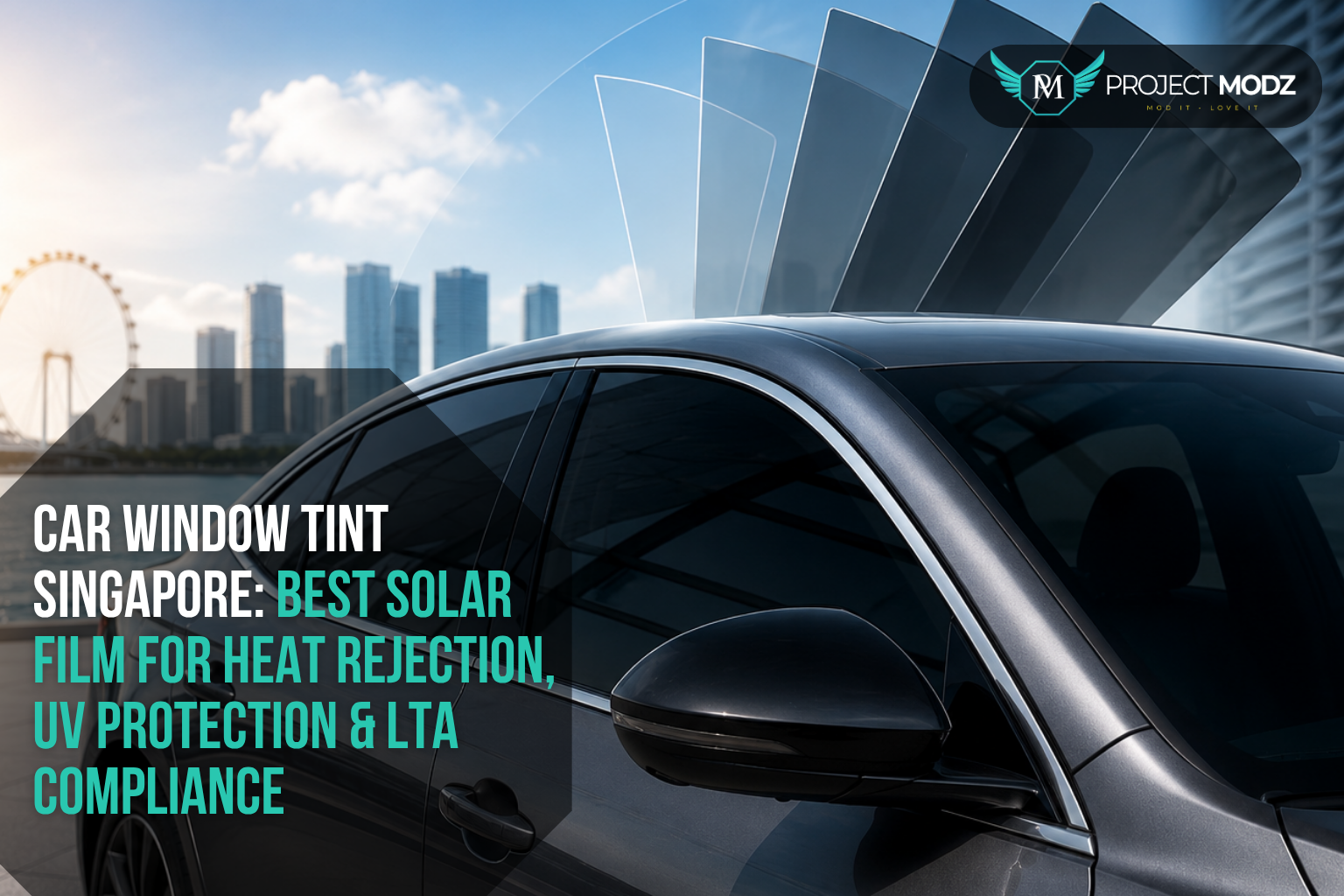
Singapore’s year-round heat and intense sunshine can turn a parked car into an uncomfortable cabin within minutes.
For many drivers, car window tinting in Singapore isn’t simply about making a vehicle look darker. A quality automotive solar film can help reduce the amount of solar heat entering the cabin, reject harmful ultraviolet radiation, reduce glare and make everyday driving more comfortable.
But choosing the right solar film isn’t as simple as looking for the darkest tint or the biggest number on a brochure.
Terms such as UVR, IRR, VLT and TSER all describe different characteristics of window film. At the same time, your final installation must meet Singapore’s LTA requirements.
At Project Modz, we believe a good window tint should deliver three things:
Heat rejection. UV protection. LTA compliance.
This guide explains what Singapore car owners should know before choosing their next automotive solar film.
Automotive window film is a thin film applied to the interior surface of your vehicle’s glass.
Depending on its construction and quality, it can help reduce:
Modern premium films can provide substantial solar protection without requiring an extremely dark appearance.
This is particularly important in Singapore because darkness and heat rejection are not the same thing.
A very dark low-quality film isn’t necessarily a high-performance heat-rejection film.
Likewise, a high-quality spectrally selective or nano-ceramic film can remain relatively light while providing strong solar performance.
Singapore’s tropical climate means cars are exposed to strong sunlight and heat throughout the year.
When a vehicle sits outdoors, solar energy enters through its windows and is absorbed by the dashboard, seats, centre console and other interior surfaces.
Those surfaces then release heat into the cabin.
This is why opening a car that has been parked under direct sunlight can feel dramatically hotter than the surrounding outdoor temperature.
A quality car solar film helps reduce the solar energy entering through the glass.
For Singapore drivers, this can mean a more comfortable cabin and less direct exposure to intense sunlight.
IRR stands for Infrared Rejection.
Infrared radiation contributes to the heat you feel from sunlight.
Generally, a higher IRR figure indicates that the film is designed to reject more infrared radiation under the specified test conditions.
Project Modz’s Platinum Solar Film is currently advertised with approximately 99% UVR and IRR, for example.
However, consumers should understand something important:
Infrared covers a range of wavelengths, and an IRR figure can depend on how and where it was measured. TSER is another useful metric because it considers total solar energy rather than infrared alone.
That’s why Project Modz recommends looking at the complete film specification, not simply choosing whichever film has the largest IRR number printed on its brochure.
UVR means Ultraviolet Rejection.
Premium automotive films are commonly designed to reject very high levels of ultraviolet radiation.
A solar film rated at approximately 99% UVR can significantly reduce UV transmission through treated glass under its specified test conditions.
This is useful for both passengers and vehicle interiors.
Long-term exposure to sunlight can contribute to deterioration and fading of materials such as:
Leather • dashboards • plastics • upholstery • trim
For owners who care about maintaining their vehicle’s interior, UV rejection should therefore be an important consideration when selecting window film.
They sound similar but measure different things.
| Rating | Meaning | Why It Matters |
|---|---|---|
| IRR | Infrared Rejection | Related to rejection of infrared radiation associated with heat |
| UVR | Ultraviolet Rejection | Measures rejection of ultraviolet radiation |
| VLT | Visible Light Transmission | Determines how much visible light passes through |
| TSER | Total Solar Energy Rejected | Measures overall solar-energy rejection |
This distinction is important.
A film can have:
High UVR but average heat performance.
Or:
High IRR but a less impressive overall TSER.
Therefore, when comparing the best solar film for Singapore weather, don’t make your decision based on a single specification.
TSER stands for Total Solar Energy Rejected.
Unlike IRR, which focuses on infrared, TSER considers solar energy more broadly.
It can therefore provide useful additional context when comparing the overall heat-rejection performance of different films.
When choosing your window film, consider:
IRR + TSER + UVR + VLT
rather than:
“Which film has the highest IRR?”
A premium film should provide a balanced combination of performance, visibility, durability and legal compliance.
VLT stands for Visible Light Transmission.
This is extremely important in Singapore because LTA specifies minimum light-transmission requirements.
A higher VLT means more visible light passes through the glass.
A lower VLT means the glass appears darker.
For example, 70% VLT allows considerably more visible light through than 25% VLT.
But there’s an important detail many car owners overlook:
You cannot simply look at the film’s VLT specification and assume your completed window will have the same VLT.
This is why Project Modz’s current installation approach involves measuring the vehicle’s existing glass before recommending the appropriate film.
This is one of the most important things to understand before installing solar film.
According to Singapore’s Land Transport Authority, tinted films must be non-reflective. At least 70% of light must pass through the front windscreen and two front side windows, while at least 25% must pass through the rear windscreen and two rear side windows. The front windscreen also must not interfere with signals between the vehicle’s in-vehicle unit and ERP facilities.
| Window | Minimum light transmission |
|---|---|
| Front windscreen | 70% |
| Front side windows | 70% |
| Rear side windows | 25% |
| Rear windscreen | 25% |
LTA also states that owners can have tinted films tested at an LTA-Authorised Inspection Centre to ensure compliance.
You may see businesses advertising:
“LTA Approved Solar Film”
But a more accurate description is:
LTA-compliant window tint
What matters is whether the completed installation satisfies LTA’s applicable requirements.
That distinction is particularly important because your vehicle may already have tinted factory glass.
Suppose your original window transmits 80% of visible light.
Installing film over that glass changes the final amount of light passing through the complete glass-and-film system.
This means choosing a film purely because its specification says “70% VLT” doesn’t necessarily mean your completed front window will achieve 70%.
Project Modz’s current window-tinting process addresses this by measuring the vehicle’s factory glass with a VLT meter before recommending a film.
That is particularly important for the front windscreen and front side windows where the minimum requirement is 70%.
No.
This is one of the biggest misconceptions about automotive window tint.
Darkness relates primarily to visible light transmission.
Heat rejection depends on the film’s construction and its interaction with different parts of the solar spectrum.
A cheap dark film can make a vehicle look heavily tinted while providing disappointing heat performance.
A premium nano-ceramic film can potentially provide substantially better solar performance while remaining much lighter.
So instead of asking:
“What’s your darkest film?”
Ask:
“What is the heat rejection while keeping my car LTA compliant?”
That’s a much better question.
Modern nano-ceramic window films are popular for automotive applications because they can provide strong solar performance without relying on highly reflective metallic finishes.
Depending on the particular product, benefits can include:
High infrared rejection
High UV rejection
Good optical clarity
Reduced glare
Strong heat rejection
Non-reflective appearance
Signal-friendly construction
Project Modz currently offers nano-ceramic film options and provides the relevant IRR and UVR figures for its films.
This depends on the film construction and where it is installed.
LTA specifically requires that the front windscreen must not interfere with signal transmission between the in-vehicle unit and ERP facilities.
Some older metallic film technologies can create concerns around electronic signal transmission.
This is another reason modern non-metallic nano-ceramic films are attractive for newer vehicles.
For modern cars packed with electronics, choosing the correct film technology is more important than simply choosing a shade.
There isn’t one film specification that is automatically best for every vehicle.
For Singapore conditions, I would look for a combination of:
The film should provide meaningful solar-energy and infrared rejection.
Look for premium films offering approximately 99% UV rejection, subject to the manufacturer’s specifications and testing methodology.
Heat rejection is useless if your vehicle fails inspection because the tint is too dark.
A premium film should maintain clear visibility, particularly at night and during heavy rain.
LTA requires tinted films to be non-reflective.
Particularly important for windscreens and modern vehicles.
Even excellent film can look poor when installed badly.
The quality of solar film is only half the equation.
Installation matters too.
Common problems associated with poor preparation or workmanship can include:
Dust contamination
Bubbles
Creases
Poorly finished edges
Uneven application
Visual distortion
Some temporary haze or moisture can occur during the curing period after installation, but permanent contamination and poor finishing are different issues.
A clean working environment, proper glass preparation and experienced installation all contribute to the finished result.
It’s tempting to choose window tint based purely on price.
But two films that look almost identical immediately after installation may perform very differently.
Consider:
Heat rejection
UV rejection
Optical clarity
Film construction
Colour stability
Durability
Adhesive quality
Warranty
Workmanship
If you’re comparing quotes, ask for the actual specifications instead of comparing only the final price.
Electric vehicles such as Tesla, BYD and XPENG often feature large glass areas and, in some models, expansive panoramic glass roofs.
This makes solar-film performance especially interesting to EV owners.
For a Tesla Model Y, for example, owners may consider a combination of:
Front windscreen solar film
Front and rear side-window tint
Rear windscreen film
Panoramic roof protection/film
The objective isn’t necessarily to make the vehicle extremely dark.
It is to achieve a good balance of:
Heat rejection + UV protection + visibility + LTA compliance
These shouldn’t be confused.
Solar window film is primarily intended to manage solar performance, glare and UV exposure.
Panoramic roof PPF provides a physical protective film layer over the glass and is primarily a protection product.
Depending on the vehicle and product specifications, some owners may consider different solutions for different areas of the car.
This is why it is better to discuss the whole vehicle with your installer instead of assuming one film should be applied everywhere.
The best time is generally when it suits your ownership needs—you don’t have to wait for a vehicle to become older.
For a new car, window tinting can be considered alongside:
Paint Protection Film (PPF)
Colour PPF
Car wrapping
Panoramic roof protection
Planning these services together can also help you decide what areas of the vehicle require protection versus solar control.
Before paying for window tint, ask your installer:
What is the UVR?
What is the IRR and how was it measured?
What is the TSER?
What is the VLT?
Will you measure my existing factory glass?
Will the completed installation comply with LTA requirements?
Is the film reflective or non-reflective?
Can it interfere with electronic signals?
What warranty is provided?
What should I expect during curing?
A professional installer should be able to explain these clearly.
At Project Modz, window tint isn’t treated simply as a cosmetic upgrade.
The objective is to balance:
Heat rejection
UV protection
Optical clarity
LTA compliance
Professional workmanship
Project Modz’s current process includes measuring existing factory glass with a digital VLT meter before recommending the appropriate film. The workshop also offers nano-ceramic films and provides customers with specific IRR and UVR information for the available options.
For customers seeking maximum-performance options, Project Modz’s Platinum Solar Film is currently specified at approximately 99% UVR and IRR, subject to the product’s specifications and measurement methodology.
Most importantly, film selection should not be based solely on the biggest advertised percentage.
The right solar film is the one that combines performance, clarity, durability and legal compliance for your particular vehicle.
Singapore’s sunshine isn’t going anywhere.
But you can reduce the amount of solar heat and UV radiation entering your vehicle with the right automotive window film.
Whether you drive a daily commuter, luxury vehicle, performance car, Tesla or another EV, Project Modz can recommend a solar-film option based on your vehicle’s existing glass and your priorities.
Contact Project Modz and have your car professionally tinted with premium solar film designed for Singapore driving conditions.
Project Modz — The Difference Is In The Details. Since 2017.
📍 53 Ubi Ave 1, Paya Ubi Industrial Park #01-35, Singapore 408934
📲 WhatsApp: +65 8061 1616