You have just collected your new car.
The paint is flawless. The bonnet is spotless. There are no stone chips, scratches or swirl marks.
Then comes the question:
Should I install Paint Protection Film (PPF)?
For many car owners in Singapore, this is one of the first decisions to make after purchasing a new vehicle.
PPF isn’t a small investment, so it is reasonable to ask whether it is actually worth installing.
The short answer?
If maintaining your vehicle’s original paint condition is important to you, quality PPF can provide a valuable additional layer of protection.
But PPF isn’t magic, and not every PPF installation provides the same result.
The quality of the film, condition of the vehicle, preparation and—most importantly—the workmanship of the installer can all affect the final result.
At Project Modz, we have been working with automotive films, car wrapping and vehicle protection in Singapore since 2017.
In this guide, we’ll explain what PPF does, what it doesn’t do, when it makes sense and what you should look for before installing it on your car.
Paint Protection Film, commonly known as PPF, is a transparent automotive film installed over a vehicle’s painted surfaces.
Think of it as a sacrificial protective layer.
Instead of your factory paint being directly exposed to everyday road and environmental conditions, the PPF takes much of that exposure first.
Modern premium PPF is typically designed to provide characteristics such as:
The objective isn’t to make your car indestructible.
It is to provide an additional layer between your original paintwork and everyday driving conditions.
Singapore may be a relatively small country, but our cars experience demanding conditions.
Vehicles are regularly exposed to:
Even a carefully maintained vehicle can gradually accumulate paint imperfections.
Anyone who regularly uses the PIE, CTE, AYE, ECP or other major roads will understand how easily small road debris can strike the front of a vehicle.
The most vulnerable areas typically include the:
A single stone chip may seem insignificant.
But after several years of daily driving, multiple chips can become much more noticeable—particularly on darker or highly reflective paint finishes.
PPF provides a sacrificial surface that can help reduce damage from many minor road impacts.
No.
PPF is often associated with supercars, luxury vehicles and high-performance cars because owners naturally want to preserve expensive paintwork.
But the principle applies to almost any vehicle.
Today, we see increasing interest in PPF from owners of:
The better question isn’t:
“Is my car expensive enough for PPF?”
It is:
“How important is maintaining my paint condition to me?”
If you intend to keep your car for several years and care about its exterior condition, PPF may be worth considering regardless of the badge on the bonnet.
Ideally, PPF should be considered while the vehicle’s paintwork is still in good condition.
This is why many owners choose to install PPF shortly after collecting a new car.
The reasoning is straightforward.
If the paint is already covered in stone chips and scratches, applying PPF afterwards doesn’t reverse that existing damage.
PPF protects what is underneath it.
Therefore:
The better the condition of the paint before installation, the better the condition you are protecting.
That doesn’t mean PPF can only be installed on brand-new vehicles.
Used cars can also receive PPF, but the paint condition should first be assessed.
Depending on its condition, paint correction or other preparation may be recommended before installation.
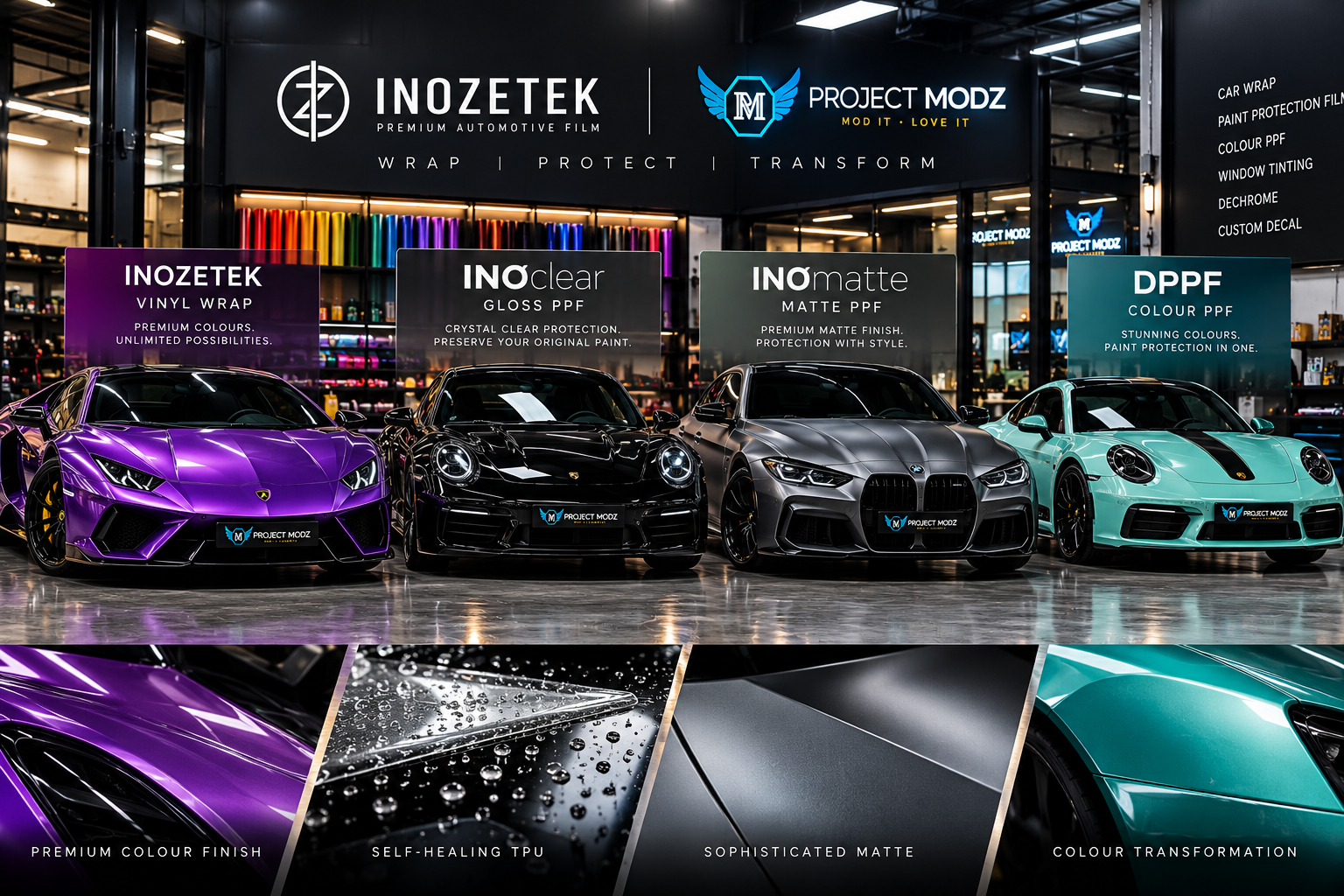
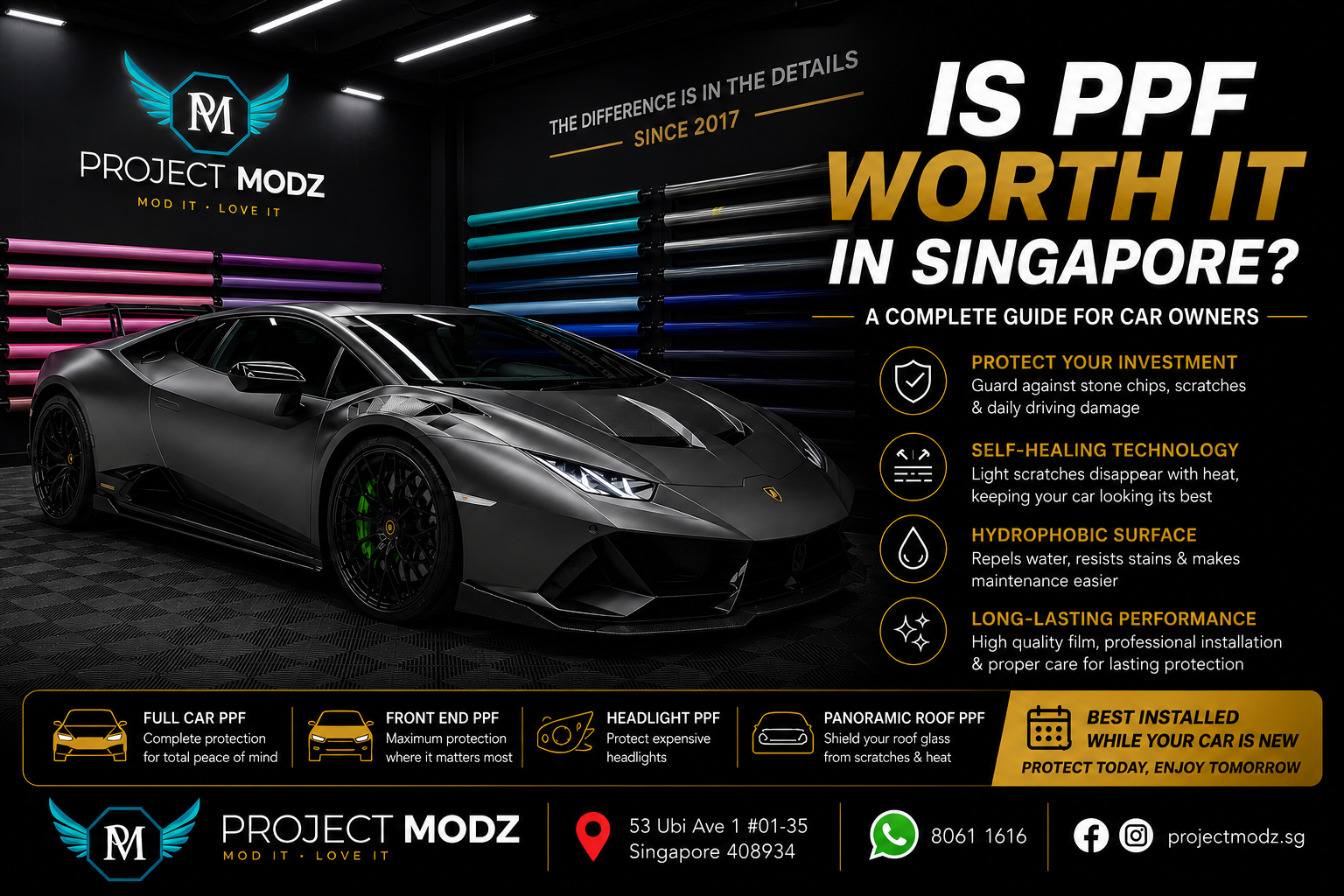
One of the most popular characteristics of modern premium PPF is self-healing technology.
However, the term can sometimes be misunderstood.
Self-healing does not mean that every scratch or impact magically disappears.
The technology generally refers to the film’s top coat being capable of recovering from certain light surface marks and fine scratches, often with exposure to heat.
This can help the PPF maintain a cleaner appearance over time.
Deep scratches, cuts or severe impacts may still permanently damage the film.
The realistic way to look at self-healing PPF is:
It can help maintain the surface of the film against minor everyday marks, but it does not make the film indestructible.
Premium PPF may also include a hydrophobic top coat.
Hydrophobic means the surface tends to repel water.
Instead of water spreading completely across the surface, it forms beads that can roll away more easily.
This can help with:
However, hydrophobic performance varies between films.
It can also change over time depending on maintenance, environmental exposure and the products used to clean the vehicle.
For this reason, PPF should still be properly maintained.
PPF can provide significant additional resistance against many minor stone impacts and road debris.
However, no responsible installer should promise that PPF makes your paint completely immune to stone chips.
A sufficiently large or high-speed impact can penetrate or damage the film.
What PPF does is create a sacrificial protective layer.
In many situations, the film absorbs an impact that would otherwise have directly contacted the painted surface.
If the PPF becomes damaged, it may be possible to replace the film on the affected panel rather than repair and repaint the original body panel.
PPF can protect against many light scratches and abrasions.
For example, minor marks caused by washing, wiping or light contact may affect the film rather than the paint underneath.
Quality self-healing PPF can also recover from certain light surface marks.
But once again, there are limitations.
A key, sharp object, accident or deep impact can cut through PPF.
PPF is paint protection, not armour.
Understanding that distinction helps owners have realistic expectations.
One of the next decisions is how much of the vehicle to protect.
You don’t necessarily need to install PPF over every panel.
For many vehicles, the front experiences the greatest amount of road impact.
A front protection package may include areas such as:
This approach concentrates protection on the areas most exposed to stone chips.
It can be a practical option for owners who want PPF protection without covering the entire vehicle.
A full-car PPF installation provides much broader protection.
This may include:
The major advantage is consistent coverage.
Instead of only protecting high-impact areas, most painted exterior surfaces receive an additional protective layer.
For owners of new, luxury, sports or high-value vehicles—or simply owners who are very particular about paint condition—full-car PPF may provide greater peace of mind.
Modern vehicle headlamps can be surprisingly expensive to replace.
They are also positioned directly at the front of the vehicle, making them vulnerable to road debris.
PPF can be applied to suitable headlamp surfaces to provide an additional sacrificial layer.
For owners who frequently travel on expressways, this is an area worth considering when planning a protection package.
Large panoramic glass roofs have become increasingly common, particularly on EVs and modern SUVs.
Because of their size and position, some owners are interested in additional protection for these areas.
Specialised panoramic roof PPF can provide an additional protective layer on suitable glass surfaces.
The appropriate product and application should be selected specifically for the glass and intended use.
Not every automotive film is designed for every surface.
This is why proper product selection matters.
No.
This is an important distinction.
Ceramic coating and PPF serve different purposes.
Ceramic coatings are primarily designed to enhance surface characteristics such as:
However, a ceramic coating is extremely thin compared with PPF.
It should not be expected to provide the same physical stone-chip protection as Paint Protection Film.
PPF is a physical film installed over the paint.
Its thickness allows it to provide significantly more protection against physical impacts and abrasions.
In simple terms:
Ceramic coating = Surface enhancement and easier maintenance
PPF = Physical paint protection
Some owners combine both approaches depending on their requirements.
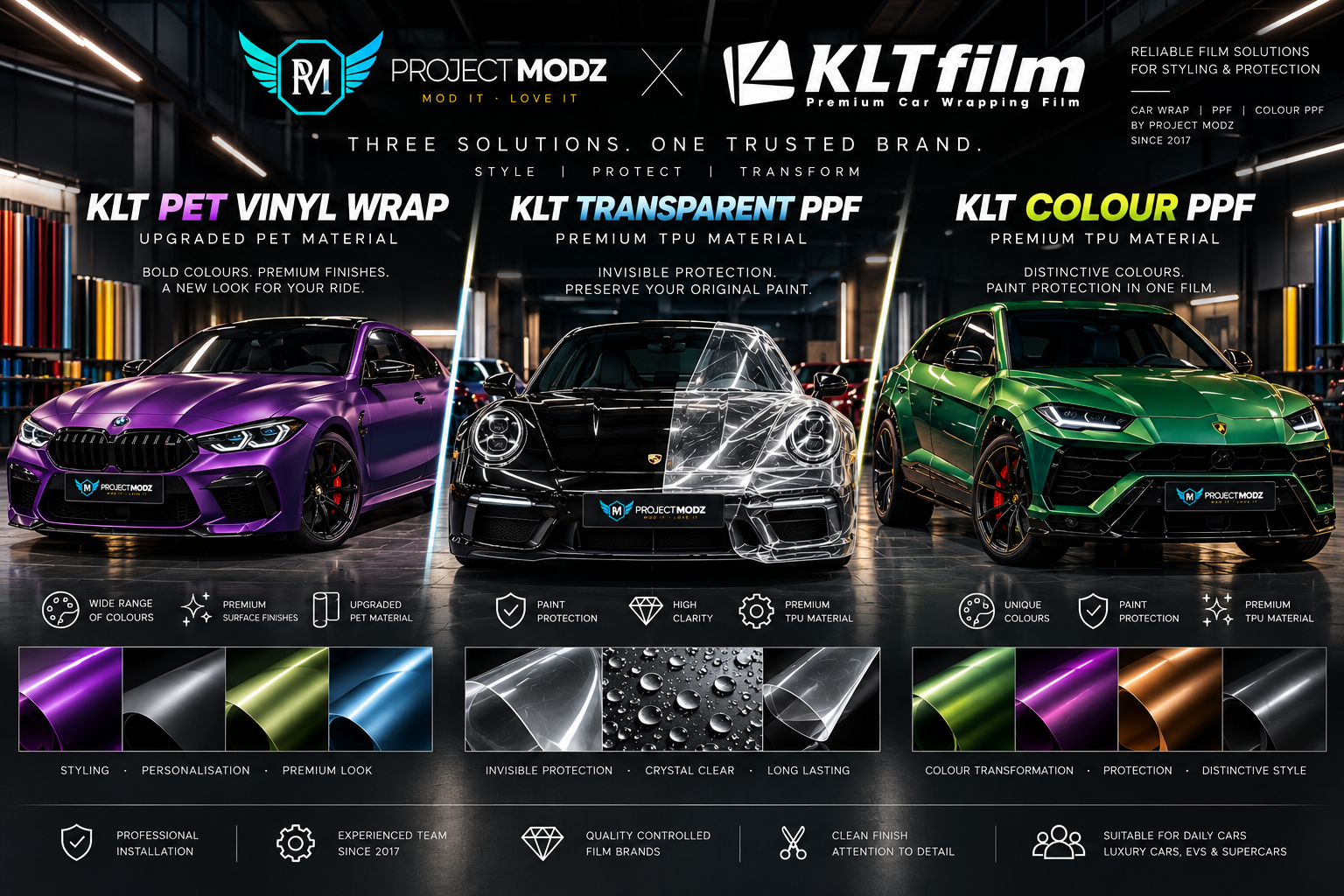
Another common misconception is that vinyl car wrap provides the same protection as PPF.
They are different products designed primarily for different purposes.
The primary purpose is to change the colour and appearance of the vehicle.
The primary purpose is to protect the original paint while keeping its existing appearance.
Colour PPF combines elements of both:
Colour transformation + physical paint protection.
If your main priority is changing your car’s appearance, vinyl wrap may be appropriate.
If protecting your existing paint is your main priority, clear PPF is generally the more suitable choice.
If you want both, Colour PPF is worth considering.
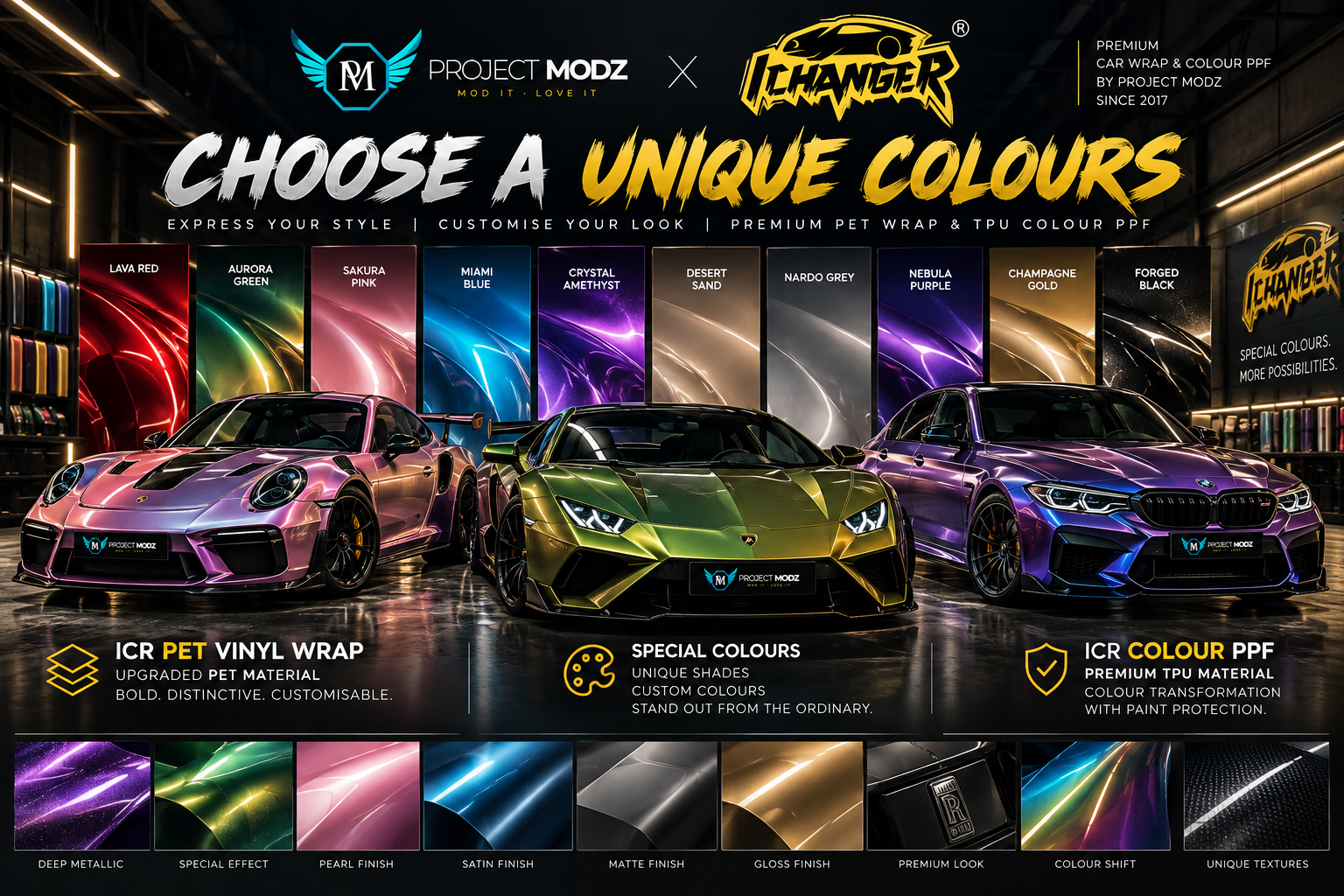
Colour PPF has become increasingly popular among car owners who don’t want to choose between customisation and protection.
Instead of applying clear film over your existing colour, Colour PPF changes the exterior appearance while providing protective characteristics similar to PPF.
Depending on the specific product, Colour PPF may offer:
It can be particularly attractive if you already planned to change your vehicle’s colour but also want more protection than traditional vinyl wrap typically provides.
High-quality clear PPF should be designed to preserve the appearance of the paint underneath.
Some premium gloss films can even enhance the visual depth and gloss of the paint.
However, clarity can vary between products.
Lower-quality films may have issues such as excessive texture, reduced clarity or inconsistent appearance.
This is why viewing physical film samples and completed vehicles can be useful before deciding.
Material quality matters.
Not all PPF is the same.
Two products may both be described as “PPF” but perform very differently.
Differences can exist in:
At Project Modz, we believe material quality should be considered carefully before a product is installed on a customer’s vehicle.
Our principle is simple:
We should be comfortable putting the product on our own car before recommending it for yours.
Customers often ask:
“Which PPF brand is the best?”
Brand and material quality are important.
But there is another question that deserves equal attention:
“Who is installing it?”
A premium film installed badly can still produce a poor result.
PPF installation requires knowledge of:
Modern cars can contain expensive and sensitive components.
Careless dismantling or cutting can potentially cause unnecessary damage.
At Project Modz, we believe the vehicle underneath the film should always be the priority.
We are installing PPF to protect the car—not to risk damaging it during installation.
PPF installation starts before the film is applied.
The vehicle should be inspected, cleaned and prepared appropriately.
Contamination trapped underneath the film can affect the finished appearance.
Panel condition should also be assessed.
If there are existing:
these can influence the installation or eventual removal.
This is one reason we don’t believe good PPF work should be rushed simply to complete more cars.
Preparation is part of workmanship.
This depends heavily on the condition and history of the paint.
Quality automotive PPF is designed to be removable from suitable automotive paint.
However, factory paint and previously repaired paint aren’t always the same.
If a vehicle has been poorly resprayed or has weak paint adhesion, there may be additional risk during film removal.
Proper removal technique also matters.
A responsible installer should therefore assess the vehicle rather than make a blanket promise that removal carries zero risk under every circumstance.
There is no single lifespan that applies to every PPF product.
Durability depends on several factors:
Premium films can provide years of service when properly installed and maintained.
When comparing PPF packages, look beyond a simple advertised number.
Ask what the warranty actually covers, who supports the warranty and what maintenance is required.
PPF doesn’t mean you can ignore maintenance.
Good care can help keep the film looking its best.
General practices include:
The exact care recommendations may differ between products.
Price matters.
But PPF should not be evaluated purely by asking:
“Who offers the cheapest full-car package?”
Consider what is actually included.
Two quotations may both say “Full Car PPF” but differ significantly in:
Saving money upfront may not represent better value if the material or workmanship doesn’t meet your expectations.
Your vehicle is valuable.
The product being applied directly over its paintwork deserves proper consideration.
Before choosing an installer, ask more than just the price.
Consider these questions:
Understand what you’re actually buying.
Ask about clarity, self-healing, hydrophobic performance and warranty.
Experience and workmanship matter.
Good preparation contributes to a good final result.
Ask about the workshop’s installation approach.
Different cars require different approaches.
Good service shouldn’t disappear the moment payment is completed.
For the right owner, yes.
PPF is particularly worth considering if:
PPF may be less important if exterior paint condition isn’t a major concern for you or you prefer to allocate your budget elsewhere.
There is no need to install PPF simply because everyone else is doing it.
The decision should be based on how much you value protecting your vehicle’s original paintwork.
At Project Modz, we have been wrapping, protecting and customising cars in Singapore since 2017.
Our approach to PPF is built around three things:
Premium Materials.
We focus on quality products suitable for their intended application.
Experienced Workmanship.
Good installation requires patience, knowledge and attention to detail.
Protecting the Vehicle First.
The car underneath the film always matters more than simply completing the installation quickly.
Whether you’re considering full-car PPF, partial PPF, Colour PPF, car wrapping, panoramic roof protection or premium window tint, our team can help you understand the available options before deciding.
Because protecting your car isn’t only about putting film on it.
It’s about putting the right film on it, the right way.
Project Modz
Wrapping • Protecting • Perfecting — Since 2017
53 Ubi Ave 1 #01-35
Singapore 408934
WhatsApp: 8061 1616